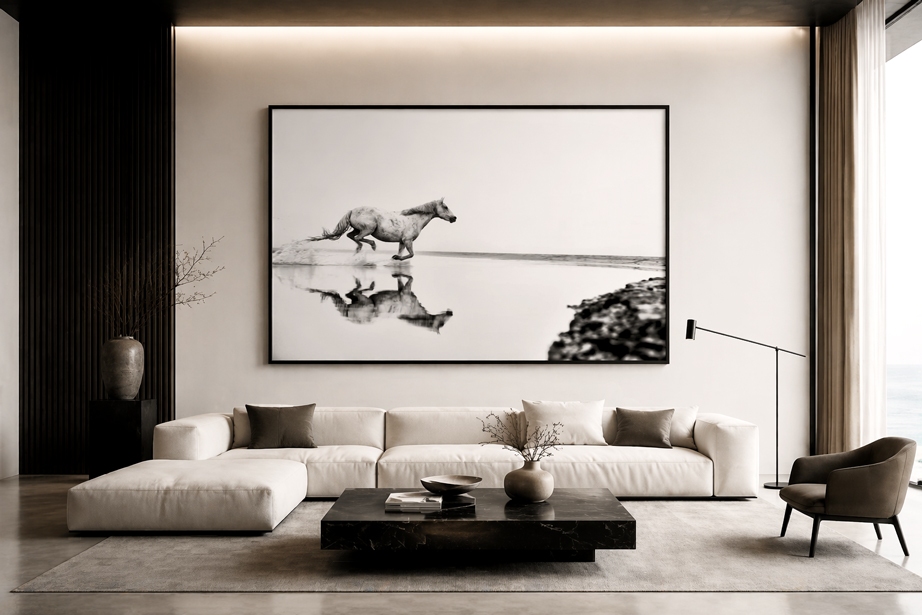
Large-scale horse photography can transform an ordinary living room into a sophisticated focal point when sized and placed correctly. The key is understanding one simple principle that removes all the guesswork from your decision.
Key Takeaways
- The “Golden Rule” of art sizing states that artwork should cover roughly 60–75% of the open wall space above a key furniture piece like a sofa or console.
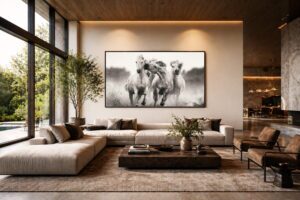
- Oversizing is usually better than undersizing—small art looks “lost” on large walls, while well-proportioned large prints feel intentional and anchoring.
- Black and white and minimal equine images are especially effective at large sizes for modern interiors, emphasizing form and musculature without color distraction.
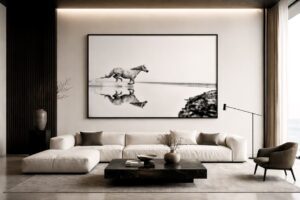
- For standard living rooms, recommended sizes range from 40×60” to 48×72”, while great rooms with 10–12 ft ceilings can accommodate 60×90” or larger panoramic formats.
- This guide will walk you through how to measure, choose size and material, and hang fine art horse photography to create a powerful living room focal point.
Why Large-Scale Horse Photography Belongs in Your Living Room
Large-format horse photography acts as an architectural structure rather than a mere decoration in contemporary living rooms. When properly scaled, a single equine image becomes the visual anchor that organizes the entire space around it.
Horses combine strength, grace, and calm in ways few other subjects can match. These beautiful animals carry an untamed spirit that resonates daily as a focal point where people relax and entertain. The visual impact of a horse’s form—the curve of the neck, the flow of the mane, the powerful stance—creates a sense of presence that paintings or abstract art often struggle to achieve.
Consider this: a single oversized equine piece above a 3-seat sofa (around 84” wide) can visually anchor a room better than multiple small frames ever could. In a 2025 open-plan living space with a 10-foot wall and neutral palette, one 48×72” horse print transforms the entire aesthetic. The room instantly has direction, mood, and scale.
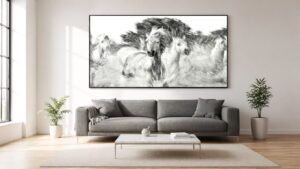
Choosing a bold, large piece often simplifies decorating decisions. Once you establish that hero image, everything else falls into place around it.
The Golden Rule of Scale: Getting the Size Right
The foundational principle for placing large-scale wall art is straightforward: artwork should typically cover 60–75% of the available wall space above a furniture piece. This ratio serves as a practical safeguard against both undersizing and oversizing.
Here’s how to measure:
- Measure the width of your sofa or console in inches
- Calculate 60% and 75% of that measurement
- Your ideal artwork width falls between those two numbers
For example, an 84” sofa calls for artwork spanning approximately 50–63” wide.
Concrete size recommendations by room type:
| Room Type | Ceiling Height | Wall Length | Recommended Art Size |
|---|---|---|---|
| Standard living room | 8 ft | 11–14 ft | 40×60” to 48×72” |
| Great room | 10–12 ft | 15+ ft | 60×90” or larger |
| Compact space | 8 ft | Under 11 ft | 30×45” to 40×60” |
A common mistake is choosing prints under 30” wide for large living rooms, creating what designers call the “postage stamp effect.” The blank wall dominates, leaving the art feeling inconsequential.
For narrow walls or spaces between windows, the same 60–75% guideline applies to the smaller span, leading to sizes like 24×36” or 30×45”.
Above the Sofa: Practical Sizing Examples
The sofa wall represents the most common living room focal point and deserves careful attention.
Standard scenario: For a typical 84” sofa on an 11-foot wall, a 50–60” wide horizontal horse print creates optimal visual balance. Hang it 6–8” above the back of the sofa to maintain a cohesive visual grouping.
Large room scenario: For a 10-foot sectional on a 16-foot wall, artwork can expand to 60–80” wide in panoramic orientation to prevent dead visual space on either side.
Pairing two prints: Two horse photographs measuring 24×36” or 30×40” hung side by side with 2–3” between them can effectively replace one giant piece. This approach works well when showcasing complementary subjects like different poses of wild mustangs or a sequence of movement.
The bottom edge of the art should generally sit about 8–10” above the top of the sofa to keep the grouping visually connected.
Height and Viewing Distance
Vertical placement and viewing distance matter as much as the dimensions of the print itself.
The center of your artwork should rest approximately 57–60” from the floor, aligning with average eye level when seated. This positioning ensures comfortable viewing without craning necks upward.
Match print size to viewing distance:
- 10-foot viewing distance: 40–60” wide prints provide immersive detail
- 10–15 foot viewing distance: 60×90” or larger works optimally
- Under 8-foot viewing: Consider 30–45” widths to avoid overwhelming the space
Modern homes built after 2015 often feature open-concept layouts where primary seating sits 10–15 feet from focal walls. These spaces naturally accommodate larger artwork.
Before purchasing, use painter’s tape or paper templates on the wall at full size. This 15-minute exercise prevents costly mistakes and confirms scale in your actual living space.
Creating a Living Room Focal Point with Equine Imagery
Every well-designed living room benefits from a single visual focal point—one element that immediately draws the eye and establishes hierarchy. Large horse photography naturally fills this role through sheer presence and subject matter.
The strong lines of a horse’s neck, mane, and shoulders direct the eye across the room while complementing architectural elements like windows and fireplaces. Unlike busy patterns or competing colors, a well-composed equine image organizes visual attention rather than fragmenting it.
Strategic placement tips:
- Position the hero equine print on the wall directly opposite the main seating area
- Coordinate orientation with furniture: horizontal images for wide sofas, vertical for narrow walls
- Use one main horse piece as the anchor; let smaller works support rather than compete
The elegance of wild horse photography lies in its ability to command attention without demanding it. A single dramatic image above the sofa becomes the first thing guests notice when entering.
Choosing the Right Mood: Calm vs. Dynamic Horses
The emotional tone of your horse photograph should match how your living room functions daily.
For conversation and relaxation: Tranquil, close-up portraits work best. A black and white profile of a resting Icelandic mare, printed at 50×70”, creates a calm presence without demanding active engagement. Side-facing or three-quarter views generally feel approachable.
For gathering spaces: Dynamic running herds or wind-swept manes energize open-concept rooms that host game nights or social activities. The kinetic energy matches the room’s function.
Direct, head-on stares can feel powerful but intense at very large sizes. Consider whether that emotional impact aligns with your space.
Personal connection deepens satisfaction. Whether you’re drawn to draft horses, wild mustangs, sport horses, or thoroughbreds, selecting subjects that resonate personally brings life and awareness to daily living.
Black and White vs. Color in Modern Living Rooms
Both monochrome and subtle color horse photography work beautifully at large scale in contemporary spaces, but each serves different design goals.
Black and white equine prints emphasize musculature, motion, and form with particular clarity. They’re ideal for minimalist rooms featuring concrete, stone, or oak flooring. The absence of color directs attention entirely toward the horse’s texture, tonal range, and compositional depth.
When living rooms already include strong hues in rugs and cushions, warm-toned black and white or soft desaturated colors prevent visual competition. A 50×75” monochrome Icelandic stallion print over a natural linen sofa creates cohesion without adding competing tones.
Color photographs with muted backgrounds—foggy fields, snow, soft overcast skies—offer a compromise when you want warmth without overwhelming the palette. These images capture equine beauty while maintaining the calming nature of the space.
Materials and Finishes for Large-Scale Horse Prints
Material choice dramatically affects how large horse photographs read in a living room. The substrate, finish, and framing all influence visual impact and longevity.
Key considerations:
- All large pieces should use archival inks and archival materials to prevent fading
- Match surface and framing style to room architecture
- Consider glare, natural light exposure, and household factors (kids, pets)
- Higher-end options like acrylic face-mounting suit investment-level fine art horse prints
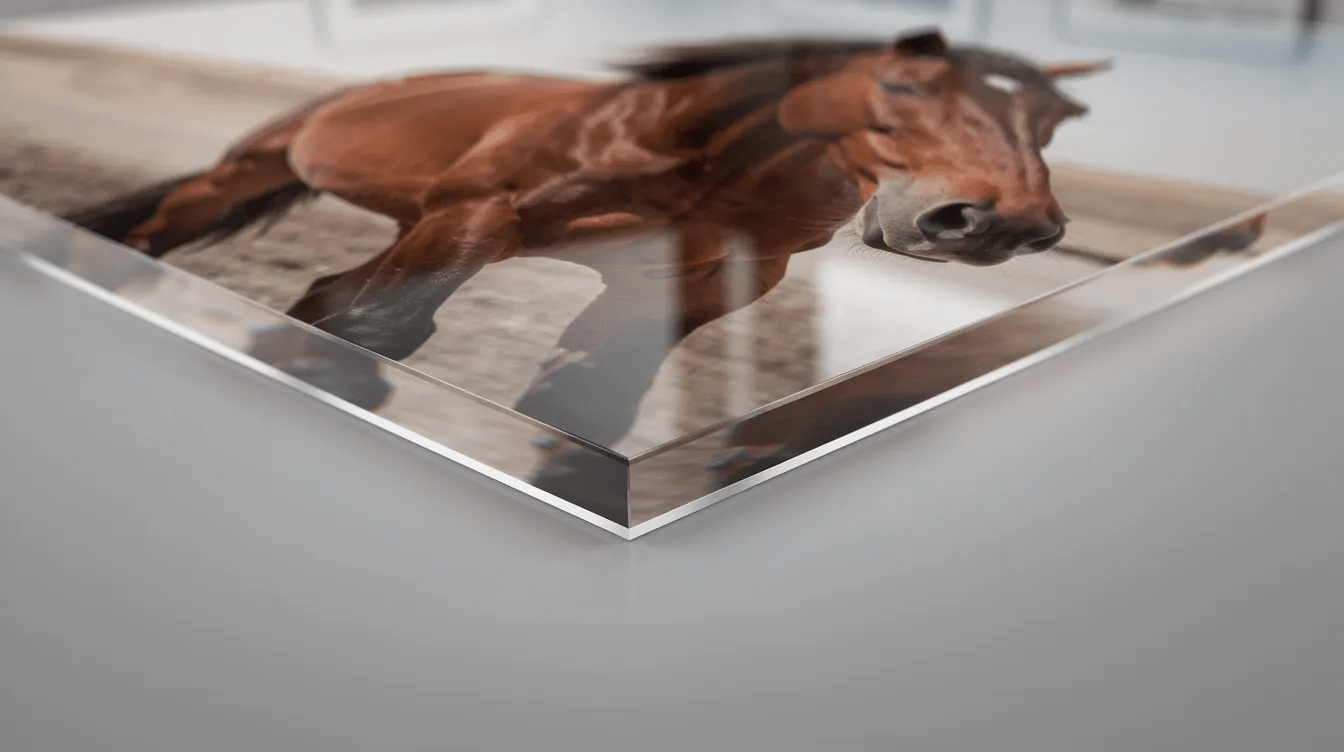
The goal is to create a statement piece that functions as great art for decades, not a temporary decoration that fades or dates quickly.
Acrylic Face-Mount: Maximum Depth and Drama
Acrylic face-mounting bonds a high-resolution print on archival paper directly to acrylic glass for exceptional clarity and depth. This finish creates a visual impact that standard framing cannot match.
Why acrylic works for large sizes:
- Maintains razor-sharp lines and deep blacks at 40×60” to 60×90.”
- Museum-grade acrylic is lighter and safer than glass for big pieces
- Available with non-glare or anti-reflective coatings for bright rooms
- Creates a floating, gallery-caliber presentation
In a modern living room, a frameless acrylic horse print appears to float above a low-profile sofa, echoing clean architectural lines. This finish transforms your space into a curated world of high-quality art.
For collectors seeking luxury presentation, acrylic face-mounting represents the premium choice for limited edition print display.
Metal, Canvas, and Framed Paper Options
Alternative materials create distinct moods suited to different living room styles.
| Material | Best For | Visual Character |
|---|---|---|
| Metal prints | Lofts, industrial spaces, modern condos | Sleek, contemporary, high durability |
| Gallery wrapped canvas | Rustic, farmhouse, transitional rooms | Softer, painterly, textured |
| Framed archival paper | Black and white portraits, classic interiors | Fine detail, traditional elegance |
Metal prints created through dye-sublimation on aluminum offer a commercial-gallery aesthetic with exceptional durability. Canvas provides a wood-like warmth through its texture, ideal where softness matters. Traditional archival paper in simple or museum frames excels for photography, where subtle tonal gradations define the beauty.
Coordinate frame color—black, white, natural oak, espresso—with existing elements like floor color and window trim to maintain visual harmony.
How to Hang Fine Art Horse Photography Correctly
Even the most beautiful large horse print looks wrong if hung too high, too low, or off-center. Proper installation matters as much as selection.
Essential hanging rules:
- Center of art at 57–60” from the floor
- Position 6–8” above the back of the sofa or console
- Center over the furniture, not the entire wall
- Use a level and proper wall anchors rated for the artwork’s weight
For acrylic or metal pieces over 40×60”, weight becomes significant. Use heavy-duty anchors appropriate for your wall type—drywall, plaster, or masonry.
Plan lighting simultaneously with hanging. This prevents later adjustments and wall patching while ensuring optimal presentation from day one.
Lighting Your Living Room Horse Artwork
Proper lighting can dramatically amplify the emotional impact of a large fine art print.
Lighting recommendations:
- Warm white LED between 2700K and 3000K flatters equine subjects
- Adjustable recessed ceiling spots or wall-mounted picture lights work best
- Aim at the center of the print, avoiding harsh glare on glossy surfaces
- Minimize direct midday sun to protect inks, even with UV-resistant substrates
Dimmable lighting lets the horse photograph subtly glow in evening hours, reinforcing its role as a focal point when the room shifts from functional space to relaxation zone.
Avoiding the “Too Big” and “Too Small” Traps
Most clients fear going too big, but the most common issue in real living rooms is art that’s too small.
Signs your print is too small:
- Large blank margins on either side of the sofa
- Artwork aligned closer to a lamp than to the furniture
- Guests stepping closer to understand the subject
Signs a piece may be too big:
- Edges almost touching adjacent walls or the ceiling
- Furniture appears dwarfed rather than complemented
The 60–75% rule reliably safeguards against both extremes. For typical 8–10 ft walls, this means artwork widths of 40–60” above standard sofas.
When in doubt, err slightly larger—especially in open-plan modern homes where rooms visually connect.
Styling Your Living Room Around Large Horse Photography
A striking horse print can serve as the starting point for all other living room decor decisions. Rather than fitting art into an existing scheme, build the room around your hero image.
Color coordination strategies:
- Extract accent colors from the artwork (mane tones, background sky, tack details)
- Repeat these subtly in cushions, throws, and rugs
- Avoid competing with the image’s dominant tones
Keep nearby decor low and simple. A minimal console, soft textiles, and carefully curated accessories preserve breathing room around oversized prints. Natural materials—linen, wool, leather, oak—echo the organic strength and spirit of the horse subject.
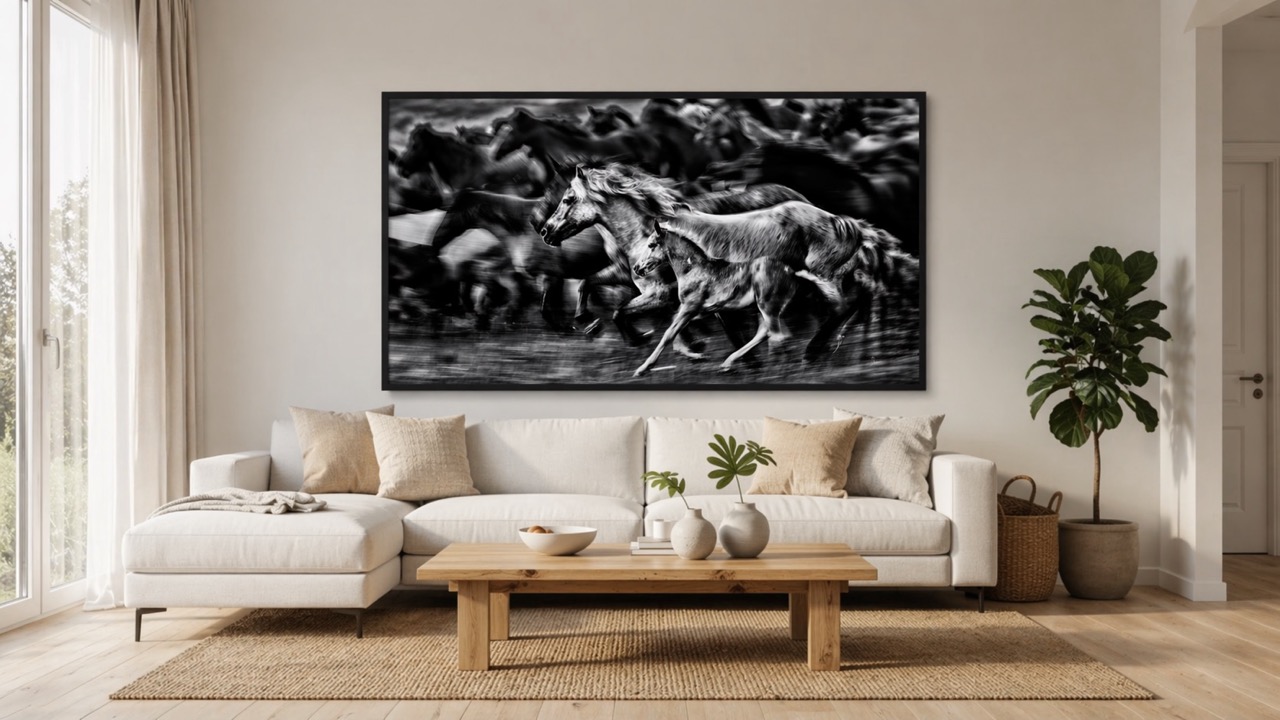
Mix surface finishes for balance: pair glossy or acrylic horse prints with matte finishes in furniture and walls.
Single Statement Piece vs. Coordinated Series
Living rooms can feature either one dramatic hero image or a carefully planned series of related photographs.
Single large print advantages:
- Clean, minimalist aesthetic
- Clear visual hierarchy
- Simpler installation and arrangement
Series advantages:
- Narrative or thematic development across a wall
- Flexibility for longer walls or adjacent dining areas
- Options for galleries featuring various sizes of the same collection
When creating a series, maintain consistent color treatment (all black and white or all warm-toned) and coordinated framing styles. Leave 2–3” between framed pieces and align top or center lines for visual organization.
Matching Horse Imagery to Different Living Room Styles
Horse photography demonstrates remarkable versatility across design styles.
| Living Room Style | Recommended Approach |
|---|---|
| Modern/Minimalist | High-contrast black and white close-ups, negative space, thin frames |
| Rustic/Farmhouse | Soft natural light portraits, running herds in fields, canvas with wood frames |
| Transitional/Loft | Sleek acrylic or metal prints, dynamic horses against simple backgrounds |
| Classic/Traditional | Framed archival paper, portraiture, elegant framing |
For modern interiors, images with generous negative space create sophisticated focal points. For rustic spaces, printed canvas or photography displayed in warm-toned wood frames complements the textured decor.
Choose subjects whose personality—gentle, fiery, introspective—matches your room’s overall mood and your personal style.
Frequently Asked Questions About Large-Scale Horse Photography for Living Rooms
Will a very large horse photograph make my living room feel smaller?
A properly sized large print usually makes a room feel more intentional and cohesive, not smaller. Overscaling one key art piece can actually expand perceived space by giving the eye a clear focal point instead of many small distractions. Following the 60–75% wall coverage guideline and keeping the surrounding decor simple prevents any sense of suffocation.
What if my living room has high ceilings—should I go taller or wider with the artwork?
In most living rooms, width matters more than extreme height because artwork still needs to relate closely to the furniture below. Use larger widths (50–80”) with moderately increased height while maintaining the center of the artwork near eye level, even in 10–12 ft ceiling rooms. Consider vertically oriented horse portraits only on narrow walls or between tall windows, where the vertical format makes architectural sense.
How do I protect a large horse print in a busy household with kids and pets?
Select durable finishes like acrylic face-mount or metal prints, which resist accidental bumps and clean easily with gentle products. Hang artwork high enough above sofas and consoles to keep surfaces out of reach. Museum-quality materials and UV-filtering acrylic also protect images from light exposure over many years, making them suitable for home offices and high-traffic living spaces alike.
Can I mix horse photography with other types of artwork in the same living room?
A single dominant horse photograph can be complemented by smaller, quieter works, such as abstract pieces or landscape photography with related colors. Keep the large horse print as the main focal point and place other art on secondary walls or adjacent areas like hallways and dining nooks. Use consistent framing styles or color palettes so the gallery wall still feels curated, not visually chaotic.
Is it better to invest in one large horse print or several smaller ones for the same budget?
For living rooms, one well-chosen large-scale print usually delivers more visual impact and clarity of intention than multiple smaller, scattered pieces. Large hero pieces often remain timeless focal points for a decade or more, becoming valued additions to any collection. Choose the best-quality, largest print that comfortably fits your primary wall and budget, then add smaller works later as inspiration strikes and your appreciation for these animals grows.