Key Takeaways
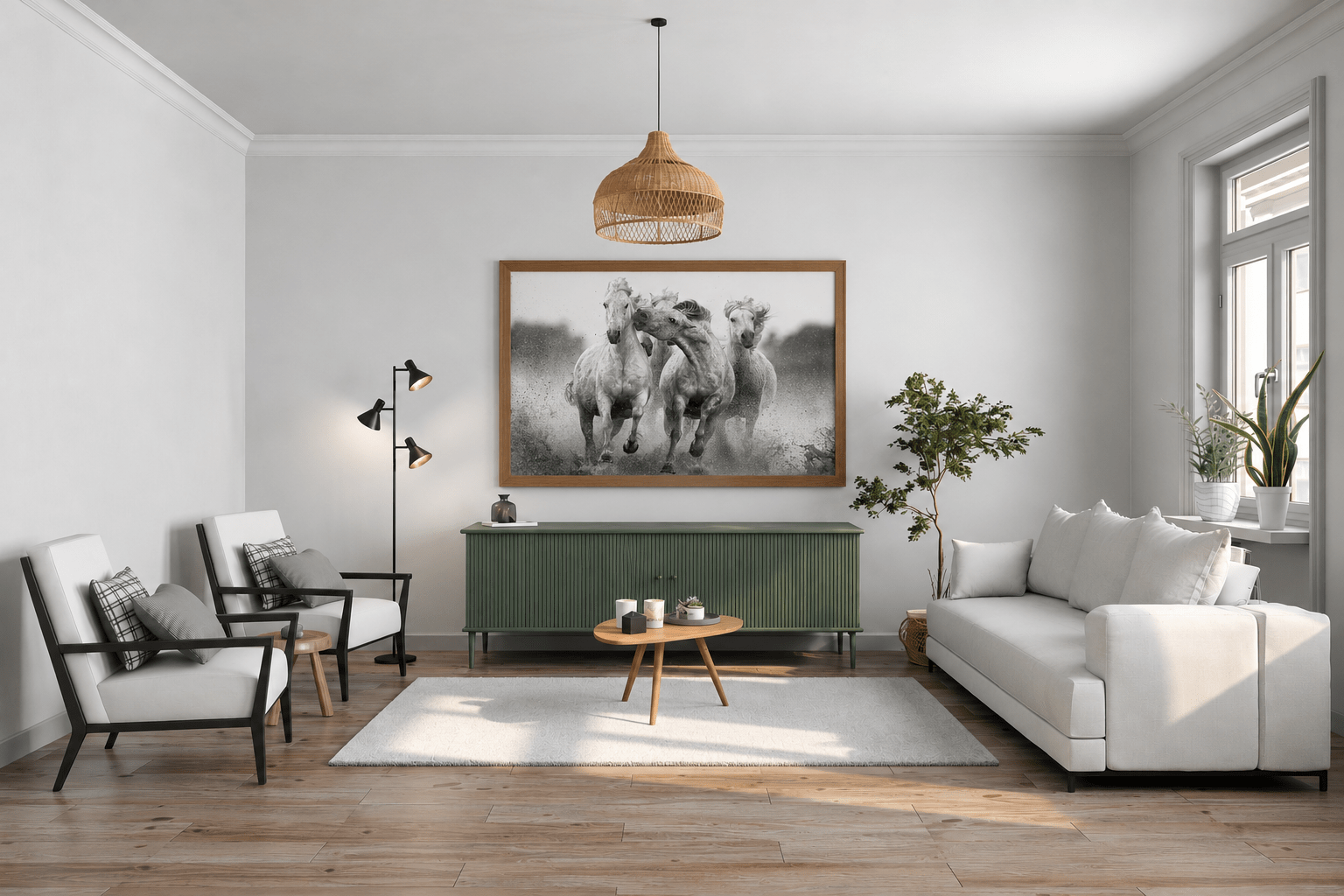
- In luxury living rooms, a single large-scale horse photograph (60–96 inches wide) creates more visual authority than multiple smaller pieces scattered across the space.
- Wall width, ceiling height, and viewing distance matter more than the specific horse image when determining print dimensions—scale dictates presence.
- Artwork above a sofa or fireplace should generally span 2/3 to 3/4 the width of the furniture, centered with the bottom edge 6–10 inches above the backrest.
- Oversized equine fine art becomes the room’s anchor, projecting calm power and confidence when balanced correctly with architecture and furnishings.
- Proper framing on archival materials elevates large horse photography from decoration to investment-grade statement art.
Why Size Matters More Than Subject in a Luxury Living Room
Consider two scenarios: a breathtaking equine image featuring dramatic light and visible brushwork, printed at a modest 24×36 inches, versus a strong but simple horse silhouette printed at 72×48 inches. In a luxury living room, the larger piece will command attention while the smaller one fades into the background, regardless of compositional complexity.
In luxury interiors designed between 2020 and 2026, designers consistently prioritize scale, negative space, and proportion over subject intricacy. A “horse statement” in fine art refers to the deliberate use of the horse as a central subject or motif to convey powerful symbolic, emotional, or sociopolitical messages. The horse acts as a metaphor for human experiences—strength, vitality, unbridled freedom, or emotional turmoil in art.
Even a modestly composed horse photograph can feel like museum-level work when printed large and displayed in a gallery-worthy frame, while a detailed image can disappear if undersized. Subject choice refines the mood, but physical size dictates presence, perceived value, and how “finished” the room feels.
How Wall Scale Determines the Right Statement Piece Size
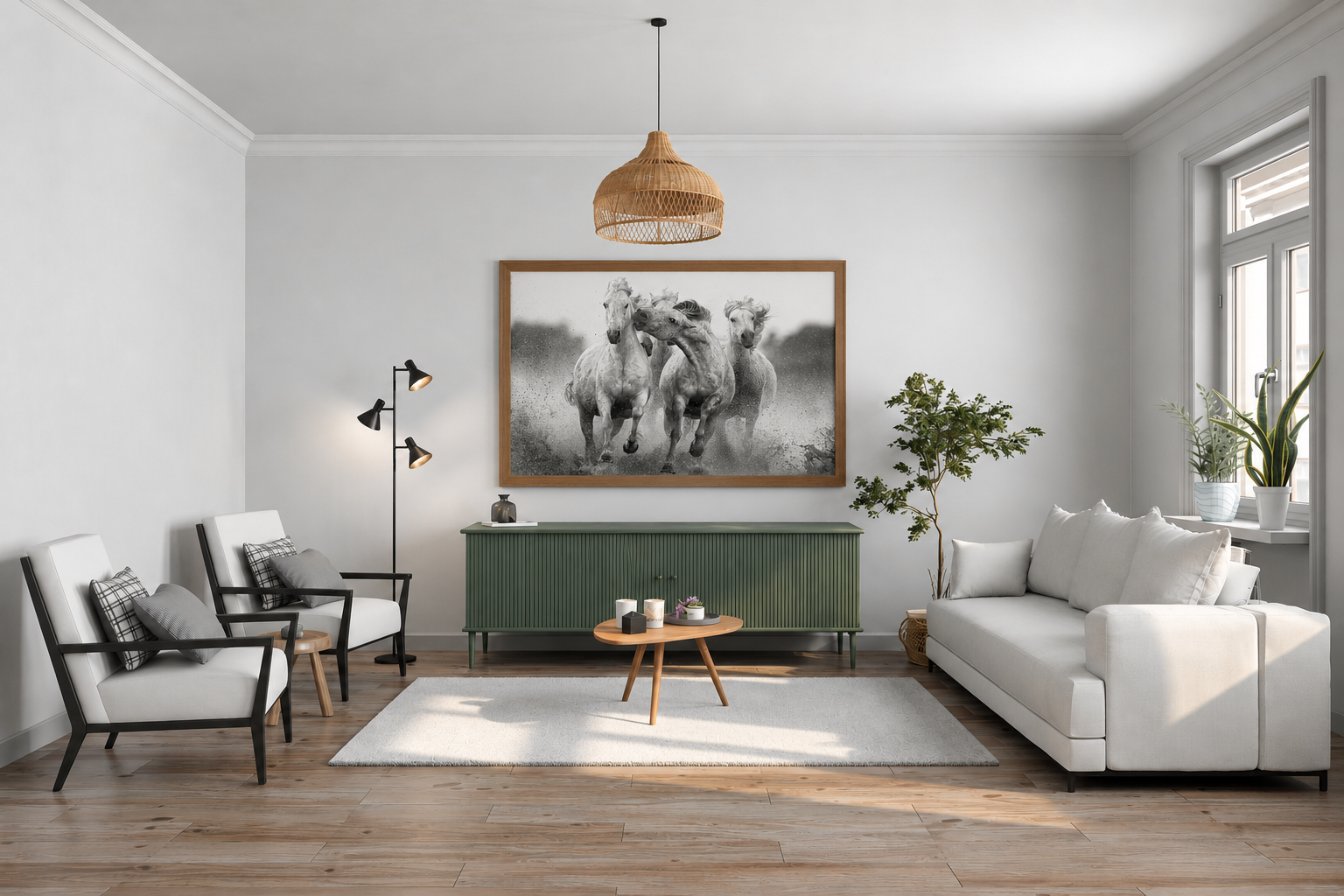
Wall width and height are your starting points before selecting any artwork orientation or frame style. The creation of equine fine art photography is a seamless collaboration between the photographer, horse handler, and horse, where each plays a pivotal role in bringing a vision to life—but that vision only reaches its potential when properly scaled to your space.
Simple rules of thumb for wall coverage:
| Wall Width | Recommended Artwork Width |
|---|---|
| 12 feet (144 inches) | 72–96 inches |
| 10 feet (120 inches) | 60–84 inches |
| 8 feet (96 inches) | 48–72 inches |
Statement horse fine art should typically cover 50–75% of the open wall width, leaving at least 6–12 inches of breathing room on each side. For tall, narrow walls, consider vertical horse portraits at 40×60 or 48×72 inches. Long horizontal walls suit panoramic horse images at 60×40, 72×48, or 80×50 inches—formats that emphasize movement and capture the grace inherent in equine subjects.
Large-scale horse photography framed with slim, modern moulding preserves the sense of dimension without feeling visually heavy.
The Ideal Dimensions for Horse Fine Art Above a Sofa or Fireplace
Sofa and fireplace walls remain the most common locations for horse statement fine art in luxury living rooms. Horse photography captures the intrinsic qualities of horses, emphasizing their beauty, strength, and grace, which have been admired by humans throughout history—making these prominent placements ideal for showcasing such subjects.
Sofa guidelines:
- Artwork width should span roughly 2/3 to 3/4 the width of the sofa
- For an 84-inch sofa, select a 56–72 inch wide piece
- Bottom of the frame sits 6–10 inches above the sofa back
- Center the artwork at approximately 57–60 inches from the floor (average eye level)
Fireplace considerations:
- Artwork should not exceed the width of the mantel
- A 60-inch print works above a 72-inch mantel
- A 48-inch print suits a 60-inch mantel
Common luxury-scale print sizes for these placements include 40×60, 48×72, and 60×90 inches. With standard 9–10 foot ceilings, these dimensions read as immersive rather than overwhelming, transforming the wall into a striking composition that anchors the entire room.
When to Choose Oversized vs Medium-Scale Horse Photography
In living room terminology, “oversized” typically means widths of 70 inches and above, while “medium-scale” ranges between 40 and 60 inches wide.
Oversized works best when:
- You have an expansive open-concept room
- Walls exceed 10 feet in width
- Furniture is minimal and a single focal point is needed
- Ceiling heights reach 10 feet or higher
Medium-scale is ideal for:
- More intimate seating areas
- Rooms with multiple windows or built-ins
- Pairing artwork with sconces or shelving
- Homes with 8-foot ceilings
Consider two scenarios: a 2025 new-build with 12-foot ceilings naturally accommodates an 80×50 inch print as its defining element, while a 1990s home with 8-foot ceilings finds perfect balance with a 40×60 inch piece.
Oversized prints feel most luxurious when beautifully framed with narrow, gallery-style mouldings in black, white, or natural wood—keeping the focus entirely on the horse.
How Ceiling Height Influences Artwork Size Selection
Ceiling height changes how big a print feels, even if the dimensions are identical on paper. The same 48×72 inch photograph will appear modest in a 20-foot great room but substantial in a space with 9-foot ceilings.
Size recommendations by ceiling height:
| Ceiling Height | Recommended Sizes |
|---|---|
| 8 feet | 30×45, 36×48, or 40×60 inches |
| 9–10 feet | 40×60, 48×72, or 60×40 inches |
| 12+ feet | 60×90 or 70×100 inches |
| 18–20 feet (double-height) | Truly monumental formats |
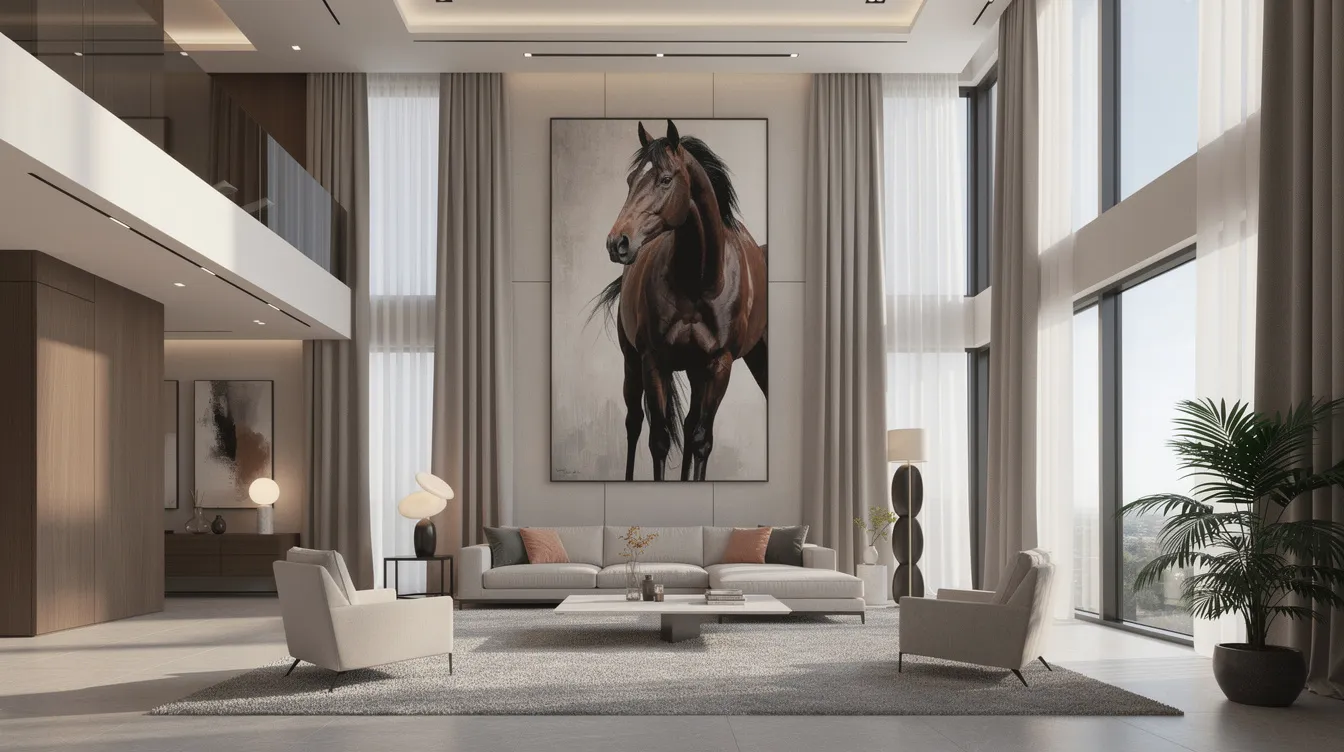
Double-height spaces—common in luxury new builds after 2018—provide the perfect canvas for substantial horse statement fine art at 60×90 inches or larger. In very tall rooms, anchor the artwork closer to the furniture rather than centering it on the entire wall height. This keeps the horse image connected to the seating area and viewing plane, preventing it from appearing to float in architectural emptiness.
Single Statement Piece vs Multi-Panel Horse Photography
The visual impact of one large piece versus a diptych or triptych depends on your room’s architecture and design philosophy.
A single large-scale piece feels bold, formal, and museum-like—ideal for minimalist or ultra-modern living rooms. By the 18th and 19th centuries, artists began to focus on the individual spirit of the horse and its place in a changing society, and a singular, commanding photograph honors that tradition.
Multi-panel horse photography works best on:
- Very wide walls exceeding 10 feet
- Spaces with long sectionals
- Gallery-style living rooms where movement across panels enhances the artistic journey
Suggested multi-panel dimensions:
- Three 24×36 inch pieces spaced 2–3 inches apart (total width ~84 inches)
- Three 30×45 inch prints spanning over 102 inches total
Multi-panel layouts should still read as one cohesive element, with consistent framing, matting, and horizon lines across the horse images. Historically, equestrian portraits highlighted the elite status of the rider, while modern artists used horses to represent untamed nature and emotional freedom—a narrative that flows naturally across connected panels.
Why Large-Scale Horse Photography Creates Authority in a Space
Large horse fine art doesn’t simply decorate a wall—it sets the emotional tone and perceived sophistication of the entire living room. Equine imagery is universally understood as a powerful statement of status, power, and prestige. In Tang Dynasty China, horses were considered symbols of prestige and success, often included in upper-class tombs to accompany the deceased. In ancient Greece and Rome, horses were expensive to train and maintain, making them enduring symbols of wealth and military prowess.
For centuries, depicting a horse in a work of art served as a visual shorthand to communicate a subject’s authority and social standing. This legacy carries into contemporary interiors, where life-size or near life-size depictions convey strength, calm power, and confidence.
A 48×72 inch, museum-quality photograph reads more like an investment piece than a small decorative print. In Western art, the horse is a cornerstone of the American frontier myth, representing independence, adventure, and the tradition of the “old west.” Designers from 2022–2026 consistently use oversized equine art to anchor open spaces and draw the eye from the entryway—creating immediate visual impact.
Notable fine art featuring horses has historically served as a powerful metaphor for human ambition, social status, and shifting cultural values. Rosa Bonheur’s depiction of a Paris market in The Horse Fair celebrates the horse’s place in daily labor and 19th-century realism, while George Stubbs focused on equine anatomy and portraits of champions, and Eadweard Muybridge’s The Horse in Motion revolutionized the understanding of movement in horses.
How Viewing Distance Impacts the Perfect Print Size
The distance between the viewer and the wall determines how much detail can be appreciated in horse fine art photography.
Distance guidelines:
| Viewing Distance | Recommended Print Size |
|---|---|
| 6–8 feet | 30×45 or 40×60 inches |
| 8–12 feet | 40×60 or 48×72 inches |
| 10–15 feet | 48×72 or 60×90 inches |
The farther back the primary seating is, the more the artwork needs to rely on bold composition, clear contrast, and generous scale. In a typical living room layout with the sofa 8–12 feet from the wall, a 48×72 inch horizontal horse print creates an immersive experience without requiring viewers to crane their necks.
High-resolution horse photography printed on archival papers ensures details like mane texture and muscle definition remain sharp even in oversized formats. Contemporary interpretations of horses in art have shifted toward abstract and emotive styles, viewing the horse as a bridge between human experience and the natural world—a connection that benefits from scale large enough to truly explore.
Balancing Furniture Proportions with Statement Art Size
Artwork must feel visually tied to the main furniture pieces to avoid looking random or adrift on the wall.
Key proportion rules:
- Art should not be narrower than half the width of the furniture below
- The ideal range is 2/3 to 3/4 of furniture width
- Deeper, more substantial sofas and sectionals can visually support larger horse artwork
Practical pairings:
| Furniture Width | Recommended Art Width |
|---|---|
| 96-inch sectional | 64–72 inches |
| 84-inch sofa | 56–63 inches |
| 72-inch console | 48–54 inches |
Frame thickness and color help balance proportions. Slim black frames sharpen modern interiors, while natural wood frames soften the relationship with oak or walnut furniture. Power and authority characterized equestrian portraits designed to project military triumph and dominance, visually reinforcing class status—and proper proportioning maintains that sense of intentional composition.
When Bigger Becomes Too Much: Avoiding Overpowering the Room
While “bigger is better” often applies in luxury spaces, there is a threshold where art can overwhelm architecture and furnishings.
Practical limits to observe:
- Maintain 4–6 inches minimum from nearby corners, ceiling mouldings, or door casings
- Always preserve a margin of negative space around the artwork
- If guests feel visually “pushed out” when seated, the print may be too large
In the 20th century, as the horse’s role in transportation and war diminished, artists began using it to represent deeper psychological or spiritual themes. A calmer monochrome horse image with a lighter background or slimmer frame profile can soften an overly dominant piece without reducing size.
For compact living rooms under 180 square feet, a medium-scale 36×54 or 40×60 inch horse artwork typically strikes the right balance between presence and comfort. Maurizio Cattelan’s taxidermied horse in The Ballad of Trotsky explores themes of failure and political utopia—demonstrating that impact comes from conceptual weight as much as physical scale.
Framing and Finishing: Turning Large Horse Prints into True Fine Art
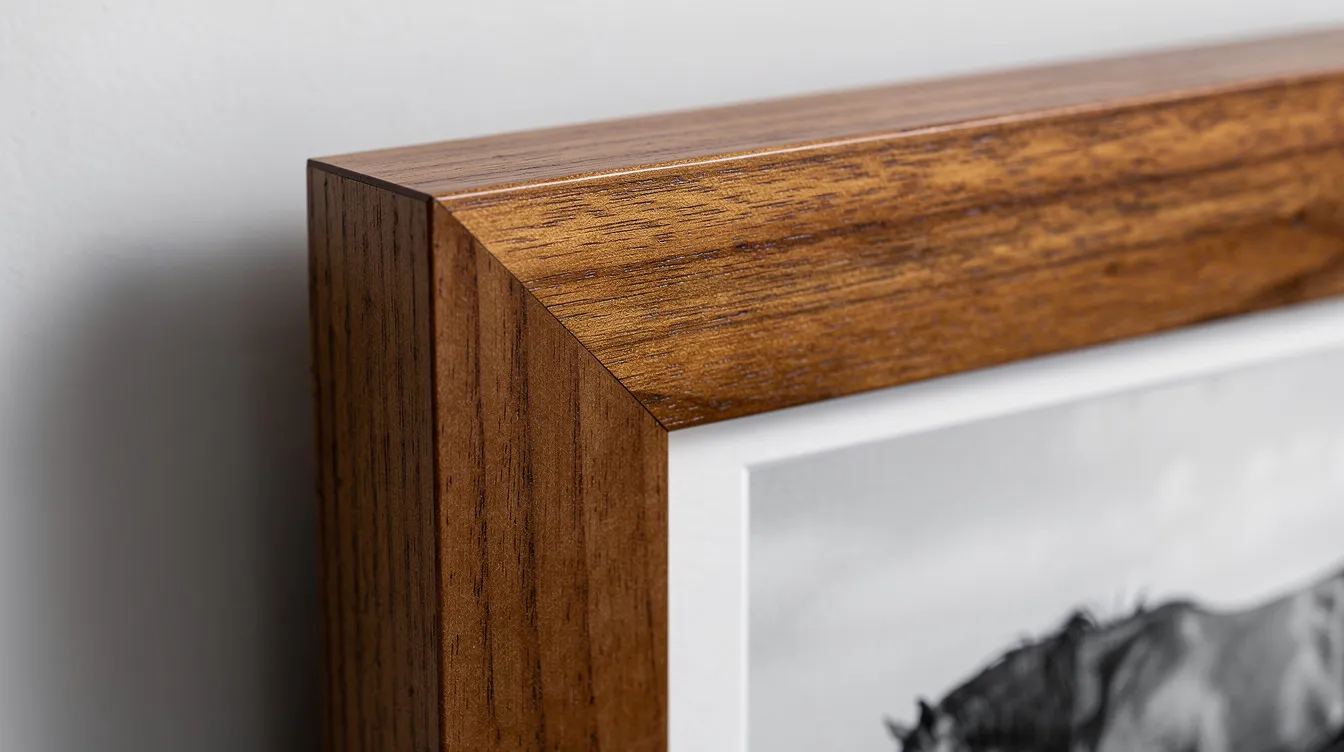
Size must be paired with the right framing to achieve a true fine art, gallery-worthy presentation. Fine art photography of horses is an intentional creation designed to evoke emotion and transform the subject into art, rather than merely documenting their likeness.
Essential framing elements:
- Archival, acid-free fine art papers (cotton rag at 310gsm)
- UV-protective glazing (99% UV block) to prevent fading
- Real wood profiles in black, white, or natural tones
- Clean lines that complement luxury interiors
For very large pieces, minimal modern mats or full-bleed presentations keep the focus on the horse as the primary element. The creation of equine fine art photography involves a collaborative effort between the photographer, horse handler, and horse, requiring a deep understanding of movement and light—craftsmanship that deserves equally thoughtful framing.
Handcrafted, gallery-quality frames with precise mounting keep large prints flat and crisp, preventing warping or waviness that can spoil the statement effect. The enduring nature of depictions of horses ensures that they remain a relevant “statement” in contemporary art—and archival framing protects that investment for decades.
Planning Your Artistic Journey: From Wall Measurements to Final Installation
Selecting the right size for horse statement fine art follows a logical progression from measurement to enjoyment.
Step-by-step process:
- Measure wall width and note any architectural features (windows, doors, built-ins)
- Record furniture dimensions of the sofa, console, or fireplace below the intended placement
- Note ceiling height to determine vertical scale limits
- Determine primary viewing distance from the main seating area
- Calculate recommended size range using the 2/3 to 3/4 furniture width guideline
- Visualize with tape by marking the intended dimensions on the wall before ordering
Horses require a different approach in photography compared to human subjects, as they are fluid and expressive, necessitating guidance from the horse handler to capture authentic moments. Effective horse handlers understand how to suggest movement rather than force it, creating an environment where the horse feels confident and expressive, which is crucial for capturing powerful images.
In many cultures, the horse is seen as a “holy” or “mysterious” companion, representing a connection to a deeper, spiritual reality. In American Western art, horses often represent untamed spirit and independence. Phidias used the Parthenon Frieze to celebrate civic glory and the integral role of the horse in sporting and religious life. The horse is one of the most enduring and depicted animals in art history, providing a rich vocabulary for artists—and selecting the right size honors that legacy.
Consider involving an interior designer or art consultant when planning very large or multiple pieces, especially in custom-built luxury homes. Artists moved away from religious dominance toward naturalism, using the horse to magnify the human figure’s status—a tradition that continues when scale, framing, and placement align to transform a beautiful horse photograph into the defining focal point of the room.
In many cultures, owning a horse was an expensive endeavor, making it an indicator of wealth—and properly scaled equine art carries that same sense of significance today.
FAQ
What is the most popular size for horse statement fine art in a modern luxury living room?
Among collectors and designers working on projects between 2022–2026, 40×60 and 48×72 inch horse photographs have emerged as the most versatile “statement” sizes. These dimensions are large enough to dominate a wall above a standard 84-inch sofa but still fit comfortably in rooms with 9–10 foot ceilings. For very expansive spaces or great rooms, 60×90 inch prints are increasingly chosen as the primary element.
Should I choose horizontal or vertical orientation for horse fine art in my living room?
Orientation should follow the wall and furniture configuration. Horizontal formats usually work best above sofas and fireplaces, while vertical pieces suit narrow walls or spaces between windows. Panoramic horizontal horse images emphasize movement and horizon lines, ideal for long seating areas. Vertical horse portraits create a more sculptural, statuesque presence and can visually “lift” lower ceilings when carefully sized.
Do I need to center the artwork on the wall or above the furniture?
In most luxury living rooms, horse statement fine art is centered above the key furniture piece (sofa, console, or fireplace), even if that means it is not perfectly centered on the entire wall. When a wall is visually divided by windows, built-ins, or doors, centering relative to the furniture keeps the room feeling balanced and intentional. Asymmetrical placements can work in contemporary design but require careful planning with scale and negative space in mind.
Can I mix a large horse statement piece with other artworks in the same room?
Mixing is possible and often successful when the horse photograph is clearly established as the main element by size and placement. Keep surrounding artworks smaller and arranged in secondary zones—reading corners or hall transitions—to avoid competing attention. Maintain a cohesive palette or framing style so the overall arrangement feels curated rather than cluttered.
Is it better to invest in one large framed artwork or several smaller horse prints?
For a luxury living room, one substantial, beautifully framed statement piece typically delivers more impact and a higher-end feel than many small pieces scattered around. Multiple smaller horse prints can be reserved for hallways, stair galleries, or casual rooms, while the main living room wall features the primary statement work. If budget allows only one major fine art investment, directing it toward a single large, archival horse photograph is usually the most transformative choice for the space.